
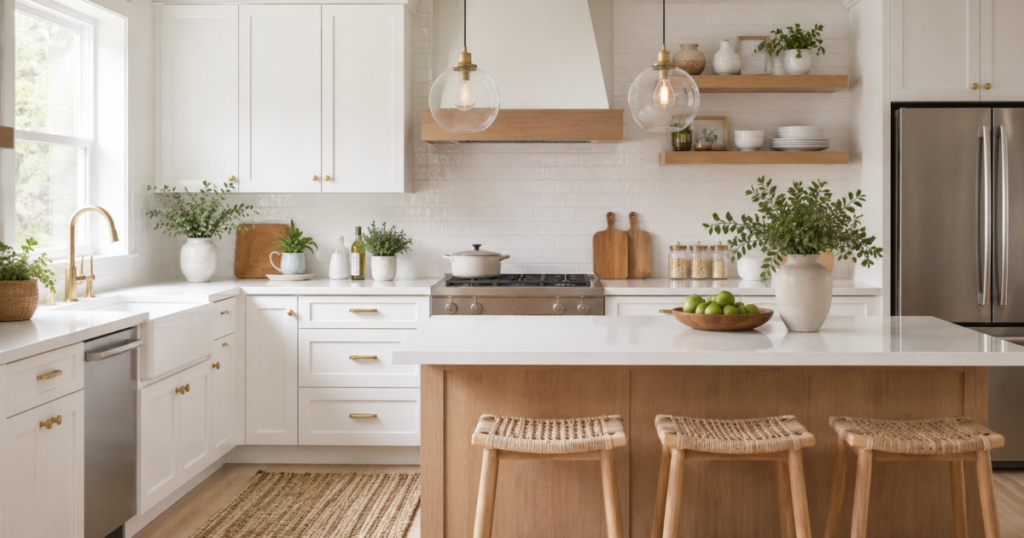
Quick answer: White kitchens are not out of style in 2026, but the all-white, cool-toned version from the 2010s has faded. Today’s popular white kitchens use warm, creamy whites paired with wood tones, brass or matte black hardware, and at least one contrasting surface, usually a wood or colored island. For apartments and small kitchens, white still works better than almost any other color because it reflects light and makes tight spaces feel larger.
White has been the most requested kitchen color for over a decade, and it remains one of the top three choices in national remodeling surveys for 2026. What’s changed is the styling: designers now warn against matching white cabinets, white countertops, white backsplash, and white walls in one flat, shadowless room. This guide covers what’s current, what’s dated, and how to apply white kitchen ideas specifically in a rental or small apartment kitchen, where you usually can’t rip out cabinets or re-tile a wall.
What Is a White Kitchen?
A white kitchen is a kitchen where the cabinetry and often the walls, countertops, and backsplash are finished in a shade of white, from stark bright white to warm off-white and cream. The term covers several distinct looks:
- All-white kitchen cabinets, countertops, backsplash, and walls are all in the white family, with color introduced only through small accents.
- Traditional white kitchen raised-panel or beadboard cabinets, ornate hardware, crown molding, and often a farmhouse sink; associated with classic and cottage-style homes.
- Modern white kitchen: flat-front or slab cabinets, minimal hardware, waterfall countertops, and clean geometric lines.
- Two-tone (tuxedo) white kitchen: white on the upper cabinets or island, paired with a contrasting wood or dark lower cabinet.
Knowing which category you’re aiming for matters because “white kitchen” searches return very different results depending on style. A traditional white kitchen with ornate trim looks nothing like a modern white kitchen with flat slab doors, even though both use the same base color.
Are White Kitchens Out of Style in 2026?
No, but the way homeowners are using white has shifted. According to recent industry research, white and off-white cabinets together still account for roughly 43% of kitchen remodels, putting white in a near-tie with wood-tone cabinetry as the most chosen finish nationally. The category hasn’t disappeared; it has split into a more nuanced set of trends.
Here’s what’s actually changing:
| Trend | Status in 2026 | Why |
| Cool, stark white (blue-gray undertone) | Declining | Reads as sterile and dated next to warmer palettes |
| Warm white/off-white (cream, greige undertone) | Growing | Pairs naturally with wood, brass, and stone |
| All-white everything (cabinets + counters + tile + walls) | Declining | Lacks contrast and shows wear |
| Two-tone “tuxedo” kitchens (white + wood or color) | Growing fast | Adds depth without abandoning white |
| White oak and other wood-tone cabinets | Growing | Now essentially tied with white as the top overall choice |
The practical takeaway: if you already have white cabinets, they are not dated on their own. What ages a white kitchen is pairing it with cool-white countertops, cool-white subway tile, and stainless everything, with no warm material anywhere in the room. Adding one warm or textured element a wood shelf, rattan stools, brass fixtures, or a colored rug keeps a white kitchen current.
Bottom line for apartment renters: since you likely can’t change your cabinets anyway, this is good news. A warm-toned rug, wood cutting boards left out as decor, brass-look adhesive hardware, and warm lighting can modernize an existing white rental kitchen without a single dollar spent on demolition.
Types of White Kitchens: Which One Fits Your Space
All-White Kitchens
Every surface cabinets, counters, backsplash, and walls sits in the white-to-cream range. This maximizes brightness, which is genuinely useful in a small apartment kitchen with one window or none. The risk is flatness, so designers now recommend varying the sheen and texture even when keeping one color family: matte cabinet paint against a glossy tile backsplash, for example, or a honed stone counter against a smooth painted door.
Traditional White Kitchens
Traditional white kitchens feature raised-panel or shaker doors, furniture-style legs on an island, and classic hardware such as cup pulls or ceramic knobs. This style is well suited to older apartment buildings with existing crown molding or plaster walls, since the ornamentation already matches the room.
Modern White Kitchen Cabinets
Modern white kitchen cabinets are flat-front (slab) doors with little or no visible frame, often finished in a satin or matte lacquer rather than traditional paint. Hardware is minimal, thin bar pulls or push-to-open mechanisms. This look photographs as “clean” rather than “cold” when paired with warm-toned flooring or a wood open shelf, and it’s a strong choice for compact galley-style apartment kitchens because the lack of visual clutter makes the room read as larger.
Two-Tone (Tuxedo) White Kitchens
Roughly a quarter of recent kitchen renovations use contrasting upper and lower cabinets, and white remains the dominant color for the upper cabinets in that pairing, with wood tones most common on the lowers. In a rental, you can approximate this look with removable wallpaper or a peel-and-stick wood finish on a lower cabinet run, or simply by choosing wood bar stools and open shelving against existing white cabinets.
Choosing the Right White: Warm vs. Cool Undertones
This is the single most common mistake in white kitchens, and it’s the reason two “white” kitchens can look completely different. Every white paint has an undertone, usually blue-gray (cool) or yellow-cream (warm), that becomes obvious once it’s on a large surface like a wall or cabinet run.
How to tell the difference:
- Cool whites look slightly blue, gray, or icy, especially under LED lighting. They pair well with stainless steel, marble, and black accents.
- Warm whites look slightly creamy or yellow, especially under warm-toned (2700K) bulbs. They pair well with wood, brass, and natural stone.
Mixing them causes problems: a warm white cabinet next to a cool white wall can make the cabinet look yellowed, and a cool white wall next to a warm white trim can look muddy.
| Popular White Shade | Brand | Undertone | Best Paired With |
| White Dove (OC-17) | Benjamin Moore | Warm, slightly creamy | Brass hardware, wood floors |
| Simply White | Benjamin Moore | Warm, soft | Light wood, natural stone |
| Alabaster (SW 7008) | Sherwin-Williams | Warm, subtly creamy | Warm hardware, shaker doors |
| Chantilly Lace (2121-70) | Benjamin Moore | Cool, crisp | Marble, black or nickel accents |
| High Reflective White | Sherwin-Williams | Very cool, stark | Modern/minimalist, stainless steel |
| Swiss Coffee | Behr | Warm, soft | Brass, farmhouse and traditional styles |
Apartment tip: you can’t repaint a rental’s cabinets in most lease agreements, but you can test whether your existing white leans warm or cool by holding a piece of white printer paper next to it in daylight. Once you know the undertone, choose your rug, curtains, and small appliances to match rather than fight it.
White Kitchens in Apartments and Small Spaces
Apartment kitchens have different constraints than a full remodel: limited natural light, no ability to move plumbing, and often a “no permanent changes” clause in the lease. White is one of the few colors that solves a real problem in small kitchens: it bounces available light around the room instead of absorbing it, which makes a galley or one-wall apartment kitchen feel less cramped.
Ways to get a current, warm white-kitchen look without renovating:
- Swap the hardware. Peel-and-stick or screw-on cabinet pulls in brushed brass or matte black instantly update a builder-grade white kitchen. Keep the original hardware in a labeled bag to reinstall before move-out.
- Add a removable backsplash. Peel-and-stick tile panels rated for kitchen use can go over an existing plain white or beige backsplash and come off cleanly at the end of a lease.
- Introduce warm lighting. Swap cool-white LED bulbs (4000K+) for warm-white bulbs (2700–3000K) in existing fixtures. This single change does more to “warm up” a stark white kitchen than almost anything else.
- Layer in wood and textiles. Open shelving with wood brackets, a woven rug, rattan bar stools, or a wood cutting board displayed on the counter breaks up an all-white palette without touching a single fixed surface.
- Use a bold small appliance or textile as the accent color. A colored kettle, a set of tea towels, or a runner rug gives the “tuxedo kitchen” contrast effect in a way that’s fully reversible.
White Kitchen Backsplash Ideas
The backsplash is the easiest surface to change in most apartments (with a removable option), and the highest-impact surface in a full remodel. Popular white kitchen backsplash choices in 2026 include:
| Backsplash Style | Best For | Notes |
| Classic white subway tile | Traditional and transitional kitchens | Timeless, but pair with a warm grout or wood shelf to avoid a flat, all-white look |
| White herringbone tile | Modern or transitional kitchens | Adds visual texture without adding color |
| White zellige tile | Modern white kitchens, quiet-luxury look | Handmade variation gives depth that flat tile lacks |
| Slab quartz backsplash (matches counter) | Modern white kitchens | Minimal grout lines, easy to clean, higher cost |
| White beadboard | Traditional/cottage kitchens | Budget-friendly, adds texture through paneling instead of color |
| Peel-and-stick tile (renter-friendly) | Apartments | Removable, no drilling or tile-setting required |
A common weak point in most white-kitchen articles is stopping at “subway tile is popular” without addressing grout. Choose a warm gray or greige grout rather than stark white grout; it hides daily grime far better and keeps the wall from looking clinical.
White Kitchen Sink: Materials, Pros, and Cons
A white kitchen sink is a classic finishing touch, especially in farmhouse and traditional white kitchens, but the material you choose determines how well it holds up.
| Material | Durability | Stain Resistance | Cost | Best For |
| Fireclay | Very high resists chips and cracks | High, though flat-bottom farmhouse styles can hold water stains if not wiped dry | Very High | Farmhouse and traditional white kitchens; heavy daily use |
| Porcelain (enamel over cast iron or steel) | Moderate enamel can chip, exposing metal underneath | Lower than fireclay; more prone to scratching | Small to Medium | Budget-conscious remodels; lighter use kitchens |
| Vitreous china | High for bathroom use, less common in kitchens | Moderate | Small to Medium | Rarely used for kitchen sinks; more common in baths |
| Granite composite (white finish) | High | High | High | Modern white kitchens wanting a non-glossy finish |
Practical notes:
- Fireclay sinks are significantly heavier than porcelain and may require reinforced cabinetry, which makes them a poor DIY choice for renters.
- White sinks of any material show coffee, tomato, and turmeric stains faster than dark or stainless sinks. Wiping the basin dry after each use and avoiding standing water are the two habits that matter most.
- Avoid bleach on both fireclay and porcelain white sinks; a baking-soda paste or a dedicated non-abrasive ceramic cleaner is safer for the glaze.
- Apartment dwellers with a stainless or dated sink can approximate the white-sink look with a white enamel dish basin insert, a fully removable option.
White Kitchen Table and Dining Ideas for Small Kitchens
Apartment kitchens rarely have room for a full dining set, so a white kitchen table is usually chosen for its ability to disappear visually rather than dominate the room.
- Round white pedestal table with no bulky legs in the corners, easiest to navigate around in a tight galley kitchen.
- Drop-leaf or extendable white table folds down against a wall when not in use, then extends for guests.
- White counter-height table with stools works as a stand-in for a kitchen island in apartments that don’t have one.
- Bistro-style two-top is the smallest footprint option for studio and one-bedroom apartment kitchens.
Pairing a white table with two mismatched wood or rattan chairs is one of the simplest ways to bring in the “warm contrast” trend without a renovation.
Pros and Cons of a White Kitchen
| Pros | Cons |
| Reflects light, making small or dark kitchens feel bigger | Shows fingerprints, grease splatter, and coffee stains more visibly than mid-tone colors |
| Neutral base that works with almost any countertop, backsplash, or accent color | An all-cool-white kitchen with no contrast can look sterile and dated |
| Strong resale appeal broadly liked by buyers and renters alike | Requires more frequent cleaning of high-touch surfaces like cabinet fronts near the stove |
| Easy to update seasonally with textiles, hardware, and lighting | Getting the undertone wrong (mixing warm and cool whites) is a common and costly mistake |
| Timeless; unlikely to look as dated as a bold trend color in 10 years | High-gloss white finishes reveal every smudge more than matte finishes |
Common Misconceptions About White Kitchens
“White kitchens are all the same.”
They’re not; a stark, cool all-white kitchen with steel appliances reads completely differently from a warm, creamy white kitchen with a wood island and brass hardware. Most of what people call “dated” about white kitchens is really about the cool undertone and lack of contrast, not the color itself.
“White kitchens are high-maintenance no matter what.”
Matte and satin cabinet finishes hide fingerprints far better than high-gloss white, and a warm white with some visible grain or texture (like a lightly glazed shaker door) shows less daily wear than a flat, ultra-bright white.
“You need to gut the kitchen to update a white kitchen.”
As covered above, hardware, lighting temperature, textiles, and a removable backsplash can meaningfully change how current a white kitchen looks without any structural work, which matters most for renters.
“White countertops and white cabinets should always match exactly.”
Designers increasingly recommend a 15–20 point difference in lightness between major white surfaces (for example, a warm white cabinet with a slightly deeper or slightly whiter countertop) so the surfaces read as distinct rather than blending into one flat plane.
Step-by-Step: Planning a White Kitchen Update in an Apartment
- Identify your undertone. Hold white paper against your existing cabinets or walls in daylight to see if they lean warm or cool.
- Check your lease for restrictions. Confirm what’s allowed: paint, adhesive tile, hardware swaps before buying anything.
- Start with lighting. Replace bulbs with a warm 2700–3000K temperature if your kitchen currently feels cold or clinical.
- Add one contrast material. Choose wood, rattan, or a warm metal for hardware, shelving, or stools.
- Choose a removable backsplash or rug if you want a stronger visual change.
- Introduce color through accessories, not fixed surfaces, so the space stays reversible at move-out.
- Photograph the “before” state of any hardware or fixtures you swap so you can restore them exactly when you move.
Key Takeaways
- White kitchens are not out of style in 2026; the cool, flat, all-white look from the 2010s is what’s fading, while warm white paired with wood or contrast is growing.
- Warm whites (creamy, yellow-based) are outperforming cool whites (blue-gray-based) in current design surveys.
- Two-tone “tuxedo” kitchens white paired with wood or a darker lower cabinet are one of the fastest-growing white kitchen trends.
- In apartments, white is still one of the most practical colors because it maximizes light in small spaces, even without a full renovation.
- Fireclay sinks are more durable and stain-resistant than porcelain but are heavier and pricier; porcelain is the budget-friendly, lower-durability alternative.
- Small, reversible changes lighting temperature, hardware, textiles, and peel-and-stick materials do most of the work in updating a rental white kitchen.
Frequently Asked Questions
1. Are white kitchens out of style in 2026?
No. White and off-white cabinets remain among the top choices nationally, close behind wood-tone cabinetry. What’s fading is the cool-toned, all-white kitchen with no contrasting material, not white kitchens as a category.
2. What is the best white paint color for kitchen cabinets?
It depends on your lighting and the undertones of your countertop and flooring. Warm whites like Benjamin Moore White Dove or Sherwin-Williams Alabaster suit kitchens with wood floors or brass hardware, while cooler whites like Benjamin Moore Chantilly Lace suit kitchens with marble or nickel accents.
3. Do white kitchens make a small apartment kitchen look bigger?
Yes. White and other light colors reflect available light rather than absorbing it, which is one of the few genuinely effective ways to make a small, low-light apartment kitchen feel more open.
4. How do I keep white cabinets and a white sink from staining?
Wipe surfaces dry after use, especially around the sink and stove, and avoid letting acidic foods like tomato sauce or turmeric sit on the surface. Use a baking-soda paste rather than bleach on fireclay or porcelain sinks, since bleach can dull the glaze over time.
5. Can I get a white kitchen look in a rental without painting the cabinets?
Yes. Swapping hardware, changing bulb temperature to warm white, adding a peel-and-stick backsplash, and layering in wood or textile accents can meaningfully update an existing white rental kitchen without violating most lease terms.